


Realization of the ministerial project "Social Responsibility of Science II" in the Wroclaw University Library
Musical items from the former school library of the Congregation of St. Ursula in Wroclaw. Dissemination of the resource
Realization of project: 2.12.2024 - 1.03.2026
The project financed by the Ministry of Science and Higher Education (Social Responsibility of Science program) included cataloguing musical works from the former library of the Congregation of the Ursuline Sisters of the Roman Union in Wroclaw.
The Ursulines, associated with evangelization and educational work from the beginning of their presence in the city, established a girls' school after settling in the Silesian capital, educating girls from various backgrounds and denominations. Their extensive educational activities allowed the congregation to avoid dissolution following the introduction of the royal decree of secularization in 1810. Despite later difficulties and restrictions imposed by the authorities, the Ursulines continued to develop their educational mission.
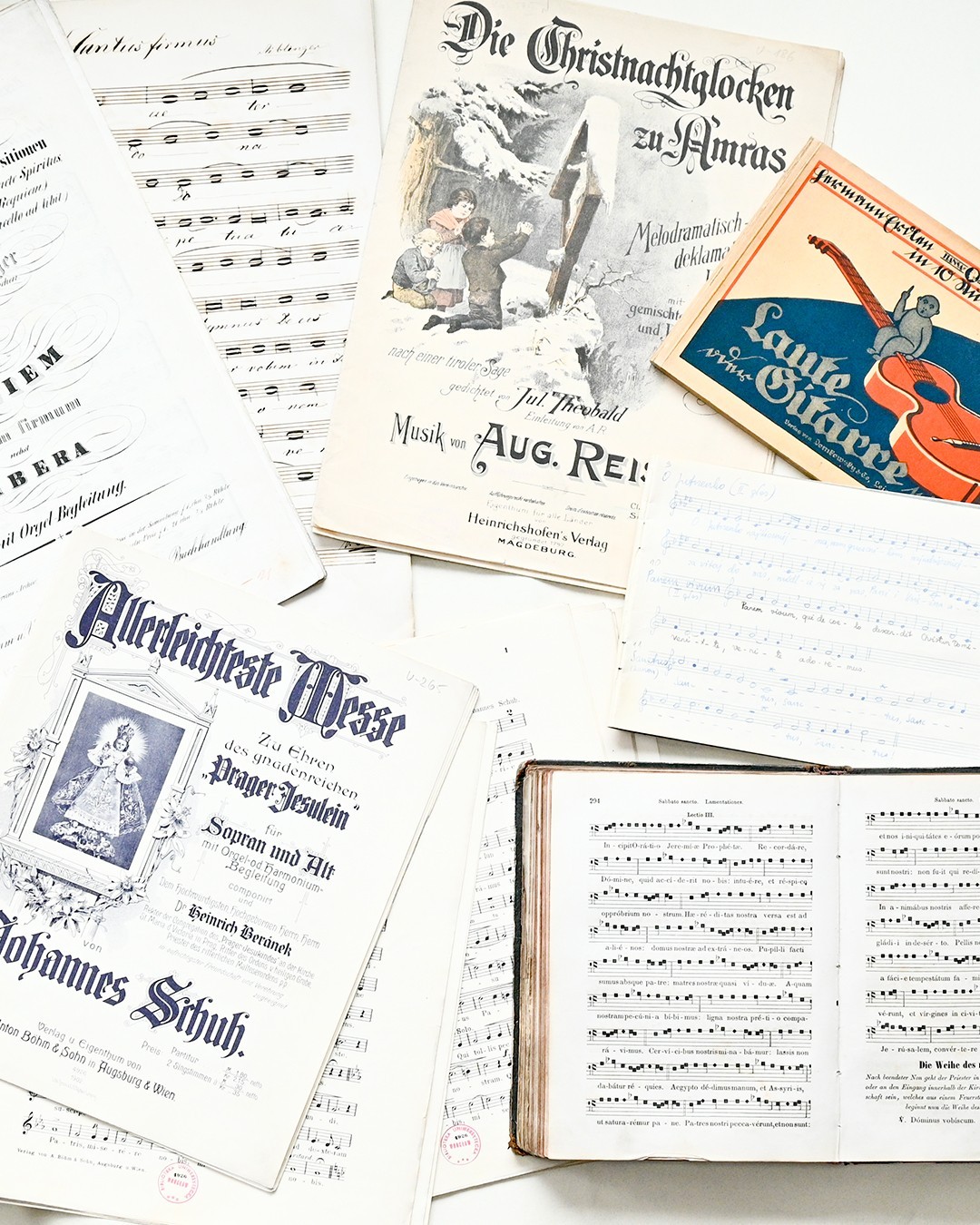
The school offered not only general education, but also practical training, language education, and intensive music education. The scale of this latter activity is evident by the extensive collection of sheet music donated to the University Library, often containing numerous notations for practical use. Students participated in the school choir, co-created the musical setting of the liturgy, and engaged in the school's musical life, as evidenced by numerous handwritten collections of songs. The importance of music in the educational process is also confirmed by the school's music studio.
As part of the project, 250 printed musical scores and 100 musical manuscripts were electronically cataloged and made available in international library databases. The printed works were cataloged in the MARC21 format, in accordance with applicable standards, enriching the records with a full set of descriptors and item descriptions. The created records were entered into the catalog of the Wroclaw University Library and the Combined Catalogs of the National Library. Descriptions of the manuscripts were made available in the international database of musical sources RISM (Répertoire International des Sources Musicales).
Among processeed manuscripts are works by composers such as Joseph Stein, Peter Piel, Ignatz Troumihler, Peter Griesbacher, Franz Schubert, Ludwig van Beethoven, Kaspar Aiblinger, and Adam Krieger. Polish accents are represented by Polish-language Christmas carols and hymns, including the particularly valuable hymn „Boga Rodzico Dziewico” with lyrics by Juliusz Słowacki. The collection is complemented by two hymns in honor of St. Ursula: the Polish Ursuline March and the German hymn "St. Ursula," inscribed in meticulous handwriting on a card decorated with a depiction of monastery buildings.
The collection of printed works is similarly diverse. In addition to local publications, it includes publications with a pan-European reach. Religious repertoire predominates, but secular works are also present, including piano, flute, lute, and guitar instruction manuals.
The collection includes materials created from the mid-19th century to the 1940s. As in previous editions of the project, in many objects have been preserved characteristic provenance marks: bookplates, old signatures and ownership annotations of the sisters.
The realization of the project and its media dissemination contributed to expanding knowledge about the history of youth music education in Wroclaw and became an impulse to undertake new researchs in this area. By providing open access to descriptions in computer catalogs and international databases, the entirety of cataloged collection has become a valuable and easily accessible source of knowledge.
Text:
Mirosław Osowski, WUL's Music Collection Department
 |
 |
Dissemination of the pre-war dissertations of the University of Wrocław in the WUL's online catalog
Realization of project: 2.12.2024 - 1.03.2026
In 2024, the University Library received funding of 33,579.00 PLN for the project: Dissemination of the pre-war dissertations of the University of Wrocław in the WUL's online catalog, financed under the Ministry of Science and Higher Education's Social Responsibility of Science II – Support for Research Libraries program. Employees from the WUL's Department for Silesian-Lusatian Documentation undertook a retrospective and comprehensive computer processing of selected items.
The University of Wrocław was established in 1811 through the merger of the Catholic Leopoldina Academy (founded in 1702) and the Protestant Viadrina (founded in 1506 in Frankfurt (Oder). Initially, it operated under the name Königliche Universität zu Breslau (in the foundation act as Universitas Litterarum Wratislaviensis), and in 1911 it was renamed to Schlesische Friedrich-Wilhelms-Universität zu Breslau. The University operated continuously until January 1945.
The first defenses of doctoral theses took place as early as 1812, while the last ones took place in 1944. During World War II, when printing theses was difficult, dissertations were also submitted as typescripts in A4 format.
Pre-war doctoral and habilitation dissertations in the WUL's collections come primarily (though not exclusively) from two sources: the preserved resources of the Königliche und Universitätsbibliothek and the Stadtbibliothek. The dissertations from the former City Library were originally intended to form part of the Wratislavian collection — a pre-war collection of printed works related to Wroclaw, arranged by topics and designated with reference numbers beginning with the letters Ya, Yb, Yc ("Y-greeks"). The doctoral theses supplemented the entry "University of Wrocław," receiving the call number Yu. Heinrich Wendt did not include them in his Katalog der Druckschriften über die Stadt Breslau (1903) and Nachtrag (1915), because he planned to prepare a separate catalog – which, however, was not created in the end.
After the war, the dissertations were incorporated into the general collections of the University Library, with the exception of materials thematically related to the Silesian-Lusatian profile. It was the items from the former Silesia-Lusatian Cabinet, now part of the Silesian-Lusatian Collection, that were included in the work of this project.
300 items were designated for retrospective computer cataloging. The selection criterion was the lack of a bibliographic record in the National Library's electronic catalog (since 2024, the Wroclaw University Library has been collaborating with the National Library within a shared cataloging environment). Each newly created record received a set of descriptors and a full description of the item. It was also necessary to create master files for the dissertations' authors, as as many as 99% of them did not previously have personal entries in the National Library.
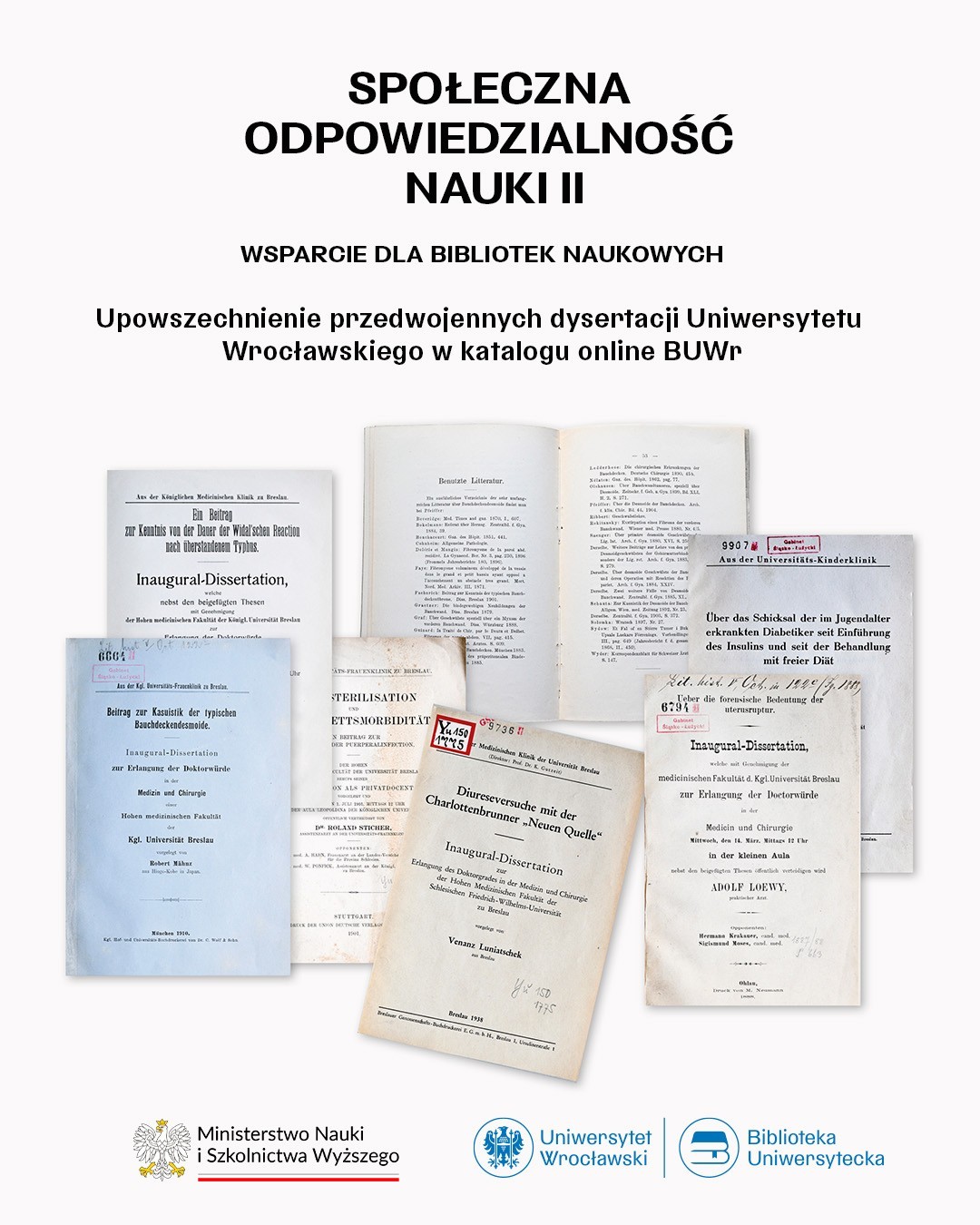
Dissertations from the University of Wrocław constitute a single, formally unified collection. Each copy is a small booklet, usually without a cover – the first page of the thesis usually serves as the cover and title page. A condition for a dissertation to be accepted for defense was its prior publication in print – not necessarily by a standalone publisher; publication in a scientific journal was also acceptable.
Offprints submitted for defense were provided with an additional title page. They differed from the book version only in pagination, retaining the original page numbering from the journal. Title pages often also included the date and time of the defense, as well as the names of the supervisor, reviewers, and faculty dean.
Another characteristic feature of this collection is the inclusion of the author's biography on the last or penultimate page of the dissertation; it was exceptionally rare for it to appear immediately after the title page. The biographies contain valuable biographical information, such as date and place of birth, full name, parents' names, father's profession, religion, educational background, and any professional experience. This data constitutes an important source for research on the social and geographical origins of contemporary scientists.
In the group of 300 dissertations processed for the project, covering the years 1831-1941, majority of works was from the field of medicine, and to a lesser extent - law and art history.
Nearly 70% of the authors came from the territories of historical Silesia, primarily from present-day Lower Silesia, but also from Greater Poland and various regions of Germany. Most of the theses were written in German, with a few in Latin. Among the approximately 300 theses, 14 were habilitation dissertations. Of the approximately 300 authors, only 17 were women, reflecting the realities of the era — women were allowed to attend lectures only from the mid-1890s, and the first woman to receive a doctorate from the University of Wrocław was Clara Immerwahr (1900).
Over 70% of dissertations were printed in Wroclaw. The most frequently used printing service was the one from the printing house Breslauer Genossenschaftsbuchdruckerei (founded in 1870), while earlier works were produced, among others, at the Korn or Robert Lucas publishing houses. Although Fraktur remained popular until the early 20th century, it was used in only seven cases.
Pre-war dissertations constitute valuable source material for scientists, historians, science researchers, and anyone interested in the intellectual culture of the region. The project's result is an expansion of the knowledge base, supplementing the WUL's electronic catalog and expanding information about the collections by introducing them into Polish and international bibliographic and scholarly circulation.
Text:
Katarzyna Grodecka, Department for Silesian-Lusatian Documentation, Wroclaw University Library
 |