


Colloquia Bibliologa Wratislaviensia in the Wroclaw University Library – lecture by Prof. M.S. Barillari
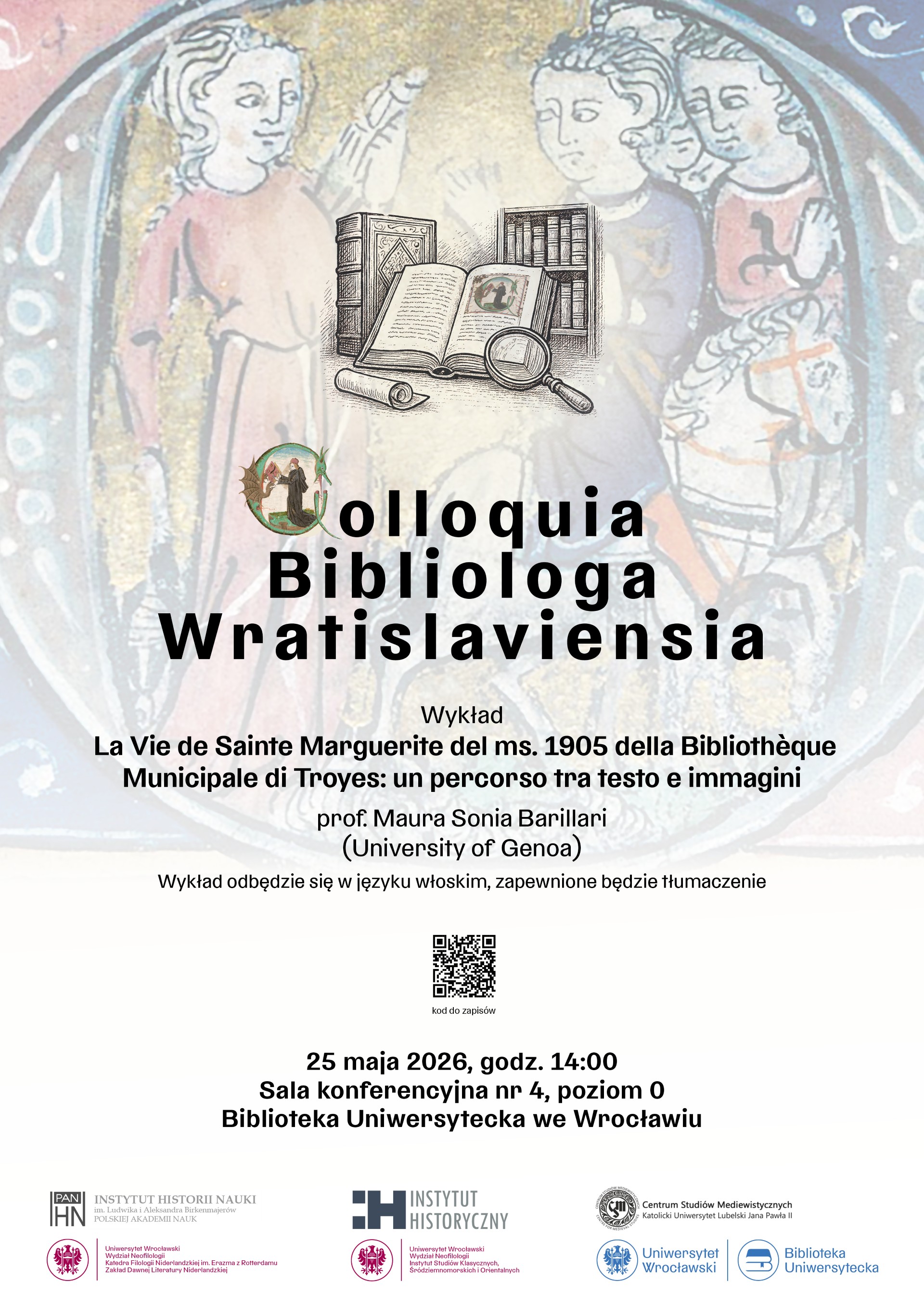
As part of the Colloquia Bibliologa Wratislaviensia series, the Wroclaw University Library will once again host a lecture, this time delivered by Professor Sonia Maura Barillari.
Ms. Sonia Maura Barillari is a professor of Romance Philology and has been conducting researches at the University of Genoa since 1991. Her main research interests focus on didactic literature and medieval theater, supporting the interpretation of texts (medieval Latin and Romance languages) with data derived from the analysis of contemporary folkloric traditions. Other areas of interest include codicology, Dante studies, the relationship between text and image, and hagiographic literature.
She is a member of the editorial board of the journal "L’immagine riflessa. Testi, società, culture" and a member of the scientific committees of the "Laboratorio Etno-Antropologico di Rocca Grimalda", the "Istituto per i Beni Marionettistici e il Teatro Popolare", the journal "Orma. Rivista di studi etnologici e storico-religiosi", the journal "Italica Wratislaviensia" (University of Wrocław, Poland) and the series "Metamorphoseion. Collana di storia delle scienze e delle tecniche" (Rome, Aracne). She is also co-editor of the series "Autunnonero. Studi sul folklore e il fantastico" (Rome, Aracne) and "Testoafronte" (Aicurzio, Virtuosa-Mente), as well as editor of the series "Collectanea" (Aicurzio, Virtuosa-Mente).
Since 2011, she has been collaborating with the Institute of Classical, Mediterranean and Oriental Studies at the University of Wrocław. Since the same year, she has been a member of the doctoral council of the doctoral program "Philology, Interpretation and History of Italian and Romance Texts" at the Faculty of Italian Studies, French Studies, Classical Philology, Fine Arts and Performing Arts at the University of Genoa. From 2012 to 2018, she served as president of the S.I.F.R.-Scuola association.
Among her publications are the monograph "Protostoria della strega. Le fonti medievali latine e romanze" (Aicurzio, Virtuosa-Mente, 2014) and critical editions: "Purgatorio di san Patrizio" by Marie de France (Alessandria, Edizioni dell'Orso, 2004); "Purgatorio di Ludovico di Sur" (Naples, Biblioteca Nazionale, Vind. lat. 57, ff. 258-263), "Studi medievali", series 3, XLIX (2008), pp. 759-808; "Jeu d'Adam – alle origini del teatro sacro" (Rome, Carocci, 2010); and "Senher que prodom mi semblas", thirteenth-century Provençal text (Aicurzio, Virtuosa-Mente, 2017).
In her lecture, "The Vie de Sainte Marguerite del ms. 1905 della Bibliothèque Municipale di Troyes: a percorso tra testo e immagini," she will examine the relationship between text and image in medieval culture, beginning with a discussion of the tradition of the Passio of Saint Margaret, attributed to pseudo-Theotimius, who presents himself as an eyewitness to the events. There are three Greek versions (BHG 1165–1167), dating from before 469, when Pope Gelasius I deemed them apocryphal. Despite this, the cult of Saint Margaret became widespread. The main version (BHG 1165) became the basis for early Latin translations from the late 8th century, before the intensification of the cult associated with the translation of relics from Antioch in Pisidia to Bolsena (908) and then to Montefiascone (1185). Four principal Latin redactions developed, giving rise to numerous vernacular versions throughout Europe.
Saint Margaret's popularity was linked to the healing powers attributed to her, particularly in protecting women in labor and newborns. This stemmed from both the symbolism of her name ("pearl," which was attributed with antihemorrhagic properties) and the episode of emerging unharmed from the dragon, interpreted as an allegory of childbirth. The hagiographic narrative depicts her martyrdom at the hands of the pagan prefect Olibria: she is tortured, imprisoned, attacked by a dragon and a demon, and ultimately beheaded.
Particular attention will be paid to Wace's vernacular version (12th century), likely considered one of his earliest works. Its purpose remains a matter of debate: it may have been political in nature, but more likely a devotional function, as evidenced by the text itself, which promises protection and healthy offspring to those who read, possess, or listen to it. The work survives in three manuscripts, including the illustrated Troyes Codex (14th century), most likely written in an aristocratic environment, perhaps at the court of Joan II of Burgundy. This manuscript contains thirteen miniatures that seem directly inspired by Wace's text, emphasizing the close connection between text and image in medieval devotional culture.
The event will take place in the Wroclaw University Library building at 12 Fryderyka Joliot-Curie St. (Grunwaldzki Campus), on 25.05.2026, in room no. 4, level 0, at 2:00 p.m. The number of places is limited.
Participation in the event is free. The lecture will be held in Italian, with translation provided.
We cordially invite you to participate in the meeting.
Link to registration:
https://forms.cloud.microsoft/e/W0TJ9WLFkb?origin=lprLink