


Machsor mechol haschana
In 2008, a joint project of the Wroclaw University Library and Sächsischen Landesbibliothek – Staats- und Universitätsbibliothek Dresden (SLUB) was realized - the digitization and presentation in the Internet of the Hebrew manuscript of Mahzor, which part I is in the SLUB's collections, while part II is - in the WUL's collections. As a result of cooperation between libraries, a digital copy of the above manuscript was created.
|
|


Entry to the digital copy:
Part I: Drezno, SLUB, Mscr.Dresd.A.46.a
Entry through the digital collection of SLUB Dresden
Entry through the Digital Library of the University of Wroclaw
Part II: Wroclaw, WUL, Ms.or.I1
Entry through the Digital Library of the University of Wroclaw
Entry through the digital collection of SLUB Dresden
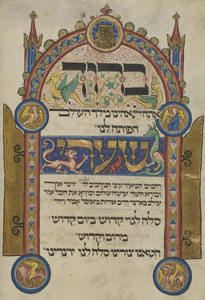 |
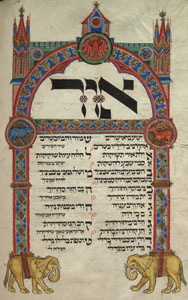 |
Machsor ("Cycle") is the Jewish equivalent of the Christian Breviary and includes prayers, partly sung, for seven specific Sabbaths and other holidays of the Jewish year, as well as liturgical poems (Pijutim).
This two-volume Codex, which is currently stored in Wroclaw and in Dresden, was created around 1290 in the Von Reu'ben area of south-western Germany (Esslingen?) and is attributed to rabbi's student Meir von Rothenburg (died 1293), and illumination to a Christian artist. The large format (53 x 38 cm, 293 or 300 parchment cards), large Hebrew square letters with quite large spacing between the lines as well as richly decorated miniatures and handwritten liturgical notes indicate the use of Codex in the synagogue. Due to the large number of pages, the manuscript, like other Mahzors, was bound in two volumes.
PThe first part (SLUB Dresden, Mscr.Dresd.A.46.a) contains liturgical texts for the Shabbat feasts "Purim", "Pessach" and "Schawout".
Part two (Wroclaw University Library, Ms.Or.I. 1) - the liturgy of the Shabbat feasts "Rosch haschana", "Yom Kippur", "Sukkot" and "Simchat Tora".
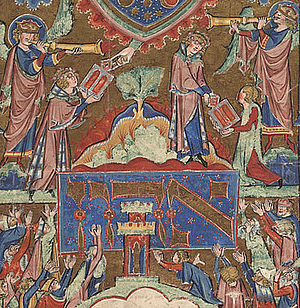 |
SLUB Dresden |
Some notes in the part from Wroclaw refer to the liturgical traditions of the Worm parish. The time of separation between the two parts is unknown so far. The oldest mention of the Dresden part is found in the "Catalogus manuscriptorum Bibliothecae Electoralis" from 1755 (SLUB, Bibl.Arch.I.B, Vol.132, No. 211). The Wroclaw part, according to the inscription from 1595, belonged to Magister Gregor Grunow, preacher in Górzyca (Göritz) near Frankfurt am Oder in the years 1595-1613, from where in 1811, together with the collections of the dissolved University of Viadrina, it reached Wroclaw.
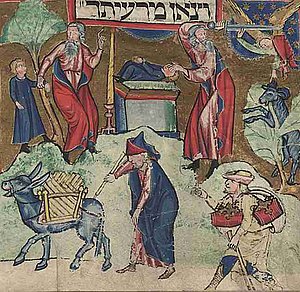 |
WUL |